
As electric vehicle technologies become increasingly widespread, charging infrastructure has gained great importance. The differences between AC and DC charging systems are among the most curious topics for users.
AC charging systems are generally preferred in homes, parking lots and low-power applications, while DC fast charging systems provide high energy transfer in a shorter time, making them ideal for commercial use.
What is an AC Charging System?
AC (Alternating Current) charging stations deliver the alternating current received from the grid to the vehicle's on-board charger. This on-board converter converts AC to DC and transfers it to the battery. Since this conversion is performed by the vehicle's own hardware, the charging speed is limited by the capacity of the vehicle's on-board charger.
- Power Range: Typically ranges from 3.7 kW to 22 kW.
- Charging Time: A 60 kWh battery can be fully charged in approximately 3 hours with 22 kW AC charging.
- Use Cases: Home charging, parking lots, workplace charging points.
- Connector Type: Type 2 (Mennekes) or GB/T.
- Cost: Lower installation and operating costs compared to DC fast charging.
What is a DC Charging System?
DC (Direct Current) fast charging stations convert the grid current to DC inside the charging station and transfer it directly to the vehicle battery. Since the vehicle's on-board charger is bypassed, much higher power charging becomes possible.
- Power Range: Ranges from 30 kW to 350 kW.
- Charging Time: A 60 kWh battery can reach 80% charge in approximately 25-30 minutes with 150 kW DC charging.
- Use Cases: Highway rest stops, shopping malls, gas stations, commercial fleets.
- Connector Type: CCS2, CHAdeMO, GB/T.
- Cost: High installation cost, but high customer turnover thanks to short charging time.
Key Differences Between AC and DC Charging
| Feature | AC Charging | DC Charging |
|---|---|---|
| Conversion Location | On-board charger (inside vehicle) | Inside charging station |
| Charging Speed | Low-Medium (3.7-22 kW) | High (30-350 kW) |
| Charging Time (60 kWh) | 3-10 hours | 15-60 min (80%) |
| Installation Cost | Low | High |
| Operating Cost | Low | Medium-High |
| Infrastructure Requirement | Standard electrical infrastructure | High-power transformer and infrastructure |
| Purpose of Use | Long-term parking, overnight charging | Fast charging, travel |
Which Charging System Should You Choose?
The right charging system selection should be determined based on usage intensity, vehicle capacity and your facility's energy infrastructure. If you plan to charge overnight at home or at work, an AC charging station is sufficient and economical. However, if you want to offer fast charging services to customers in commercial areas such as highways, shopping malls or gas stations, a DC fast charging station is the right choice.
LE-TECH Charging Solutions
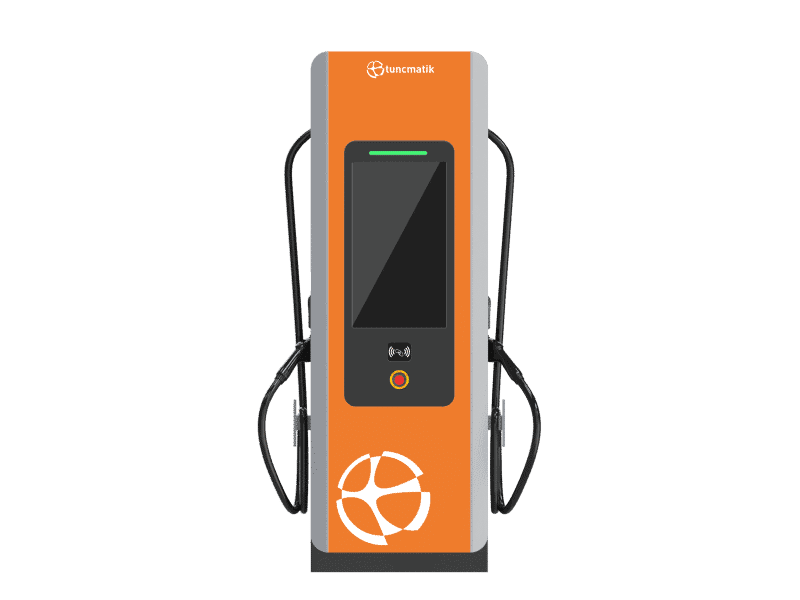
As LE-TECH, we offer charging solutions for all scales with Tunçmatik ProSeri AC charging stations (7.4-22 kW) and ProDC series DC fast charging stations (30-180 kW). We provide professional support for installation, technical service and energy infrastructure solutions. In addition, with OCPP-compatible central management software, you can monitor your entire charging network from a single platform.
For feasibility studies and price quotes for your charging station investment, you can contact our team.